
Talks · Florovivaismo, Marsala · 15 November 2011
In November 2011, at the 13th edition of Florovivaismo in Marsala (Sicily), Stefano Frapoli presented the field trial that gave rise to Maquis®. The starting question: can an extensive green roof in Italy be richer than a sedum mat, without increasing build-up depth and loads?
Beyond the sedum mat
The extensive green roofs common in Italy derive from systems developed in Central and Northern Europe: sedum mats on 7–8 cm of substrate, with very limited plant variety. On large projects almost the entire budget goes into aggregates and plastic components, leaving only a small share for the planting. The Mediterranean climate, by contrast, makes it possible to bring shrubs and perennials onto the roof, where they actively help to cool the building.
The natural model
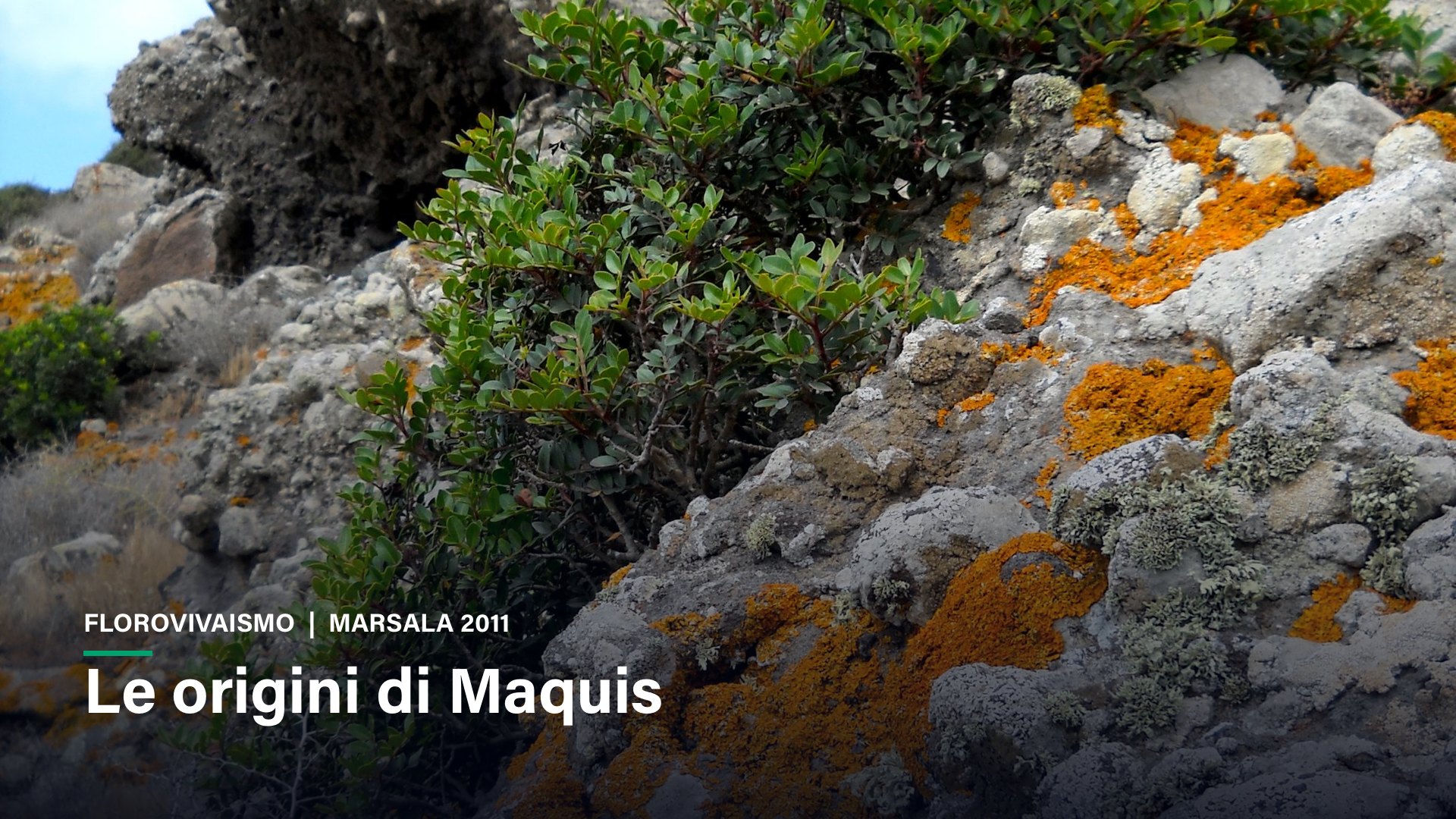
In southern Sardinia, on abandoned quarry faces in Tuscany and on landslides in the Apennines, plants grow in soils only a few centimetres deep, poor in organic matter and perfectly drained. Roots spread horizontally, foliage is compact and cushion-shaped, and the base of each plant is sheltered by stones. These are the same conditions found on a lightweight roof.
The trial on the poliflor roof
On a south-facing pitched roof in Romagna, poliflor compared several build-ups only 2–3 cm deep: perlite bags, Geoplast modules filled with pumice, and layers of volcanic lapilli. Three choices defined the system:
- Flat root-ball plants, with roots already spread out, laid on the substrate instead of planted into it.
- Planting in clusters, as in the Mediterranean scrubland, the maquis: hence the name Maquis®.
- Mineral granules over the whole surface, to capture night-time condensation on the stone and protect the substrate.
The roof was divided into sectors and monitored for a year, with the goal of not exceeding the water input of a sedum roof, about 1 l/m² per day.
~1 l
per m² per day, target equal to a sedum roof
0.4–0.8 l
per m² per day, irrigation measured in summer
24–28 °C
waterproofing membrane temperature under the planting
Trial data presented in 2011. A stable membrane temperature slows its ageing.
Maquis® today
That trial led to Maquis®: clusters of shrubs and perennials, such as thyme, lavender, rosemary and Dianthus, set within an extensive green roof. The weight stays below 100 kg/m² and a coloured granule finish conceals the drip irrigation. It is a solution for anyone who wants volume, flowering and biodiversity on a roof without the load capacity of an intensive green roof.
Ongoing research
Back in 2011 poliflor was already working on lighter, high water-retention substrates and on the Flexiverde® green wall, studying how roots behave inside the modules. The same approach, observing plants in nature and applying it to roofs and façades, still guides the development of poliflor systems today.
At a glance
Event Florovivaismo, 13th edition · Marsala
Date 15 November 2011
Speaker Stefano Frapoli, founder
Systems mentioned

Maquis®
Shrubs, aromatic herbs and flowers on an extensive green roof.
Weight < 100 kg/m² · Granules 4 colours
More talks
We have also talked about it here.
-
Flexiverde: vertical gardens with species with a tree-like effect
Among the applications of Flexiverde® technology, selecting species with a broad shrub-like habit and pronounced vertical growth makes it possible to achieve…
-
Characteristics of Poliflor systems for green roofs
Poliflor offers a wide range of extensive and intensive roof garden systems: our systems allow you to create green roofs for flat…
-
Characteristics of Poliflor systems for vertical gardens
Poliflor has been investing for years in systems, technologies and botanical research to offer its customers high quality products for the construction…
Maquis® | Technical office
Want shrubs on your roof?
Send us the roof area, load capacity and exposure: the poliflor technical office will propose plant species and build-up.